It’s 2050. How can we use backcasting to get us to a future we want — in the midst of a global pandemic?
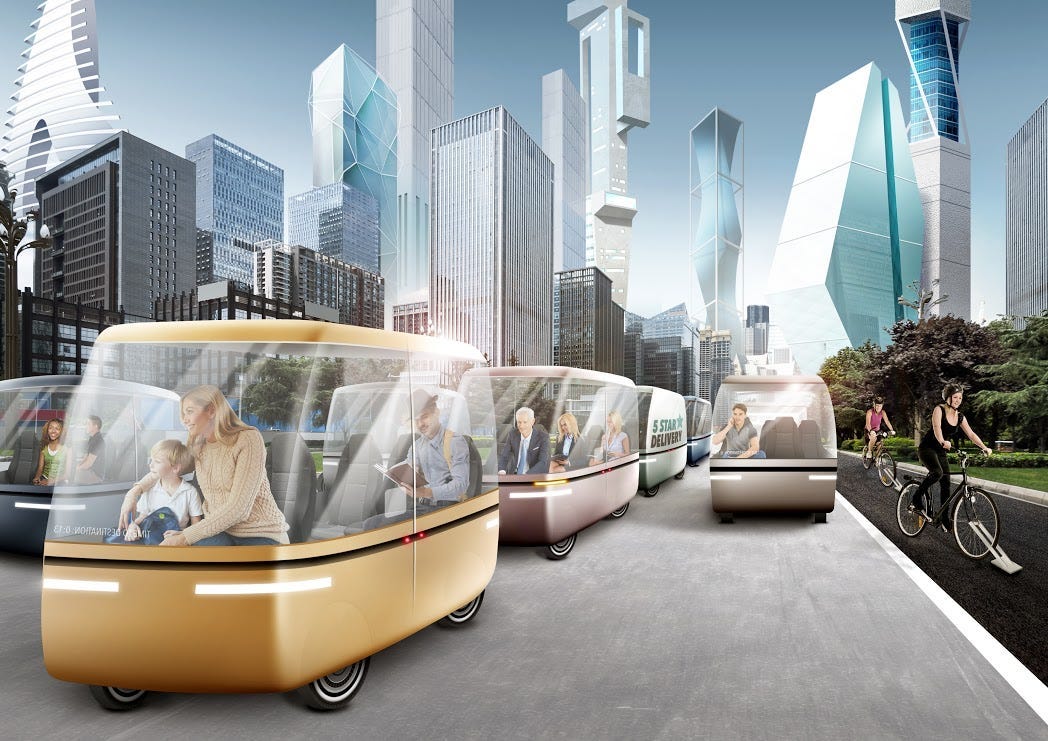
Recently my partner was commenting on a TV programme he had seen on Swedish TV called “Report from 2050” (“Rapport från 2050” på Svenska) which assumes that the Paris Agreement’s promise of zero emissions has been fulfilled, a climate change has taken place and that Sweden is climate neutral. The hosts of the show invited scientists and others to portray what everyday looks like in such a scenario, focusing on Mobility, Housing, Future’s work and food.
Interestingly enough Mobility looks like something we are experiencing now during COVID-19; Travel is shorter, aircrafts rare (and expensive) and people owning their own car is a privilege (the focus is on shared transport, electrified vehicles, and use of digitalisation for optimisation). Housing is using fossil free heating, we are living in more reduced spaces and they are all built with sustainable building materials. The future of work is affected by the change in mobility with more people working from home, as well as a big focus on automation and specialisation. The biggest change is the food landscape which has altered due to decreased imports and artificial fertilisers being replaced and we are all on a vegetable diet.
This got me thinking, there is a planning tool we use as service/strategic designers called backcasting (don’t be fooled by the name, it is actually forward thinking) where we start with defining a desirable future and then work backwards to identify policies and actions that will connect that specified future to the present.
What is backcasting?
Backcasting involves the understanding that external things are changing (technology, legislations, behaviours) and you translate past and current trends and behaviours into estimates of the future and how that will dramatically affect the landscape. Instead of focusing on the now, you start by defining a hypothetical desired future and then you work backwards as to what incremental changes need to happen to get there.
How is this different from forecasting? Hopefully this diagram can explain:
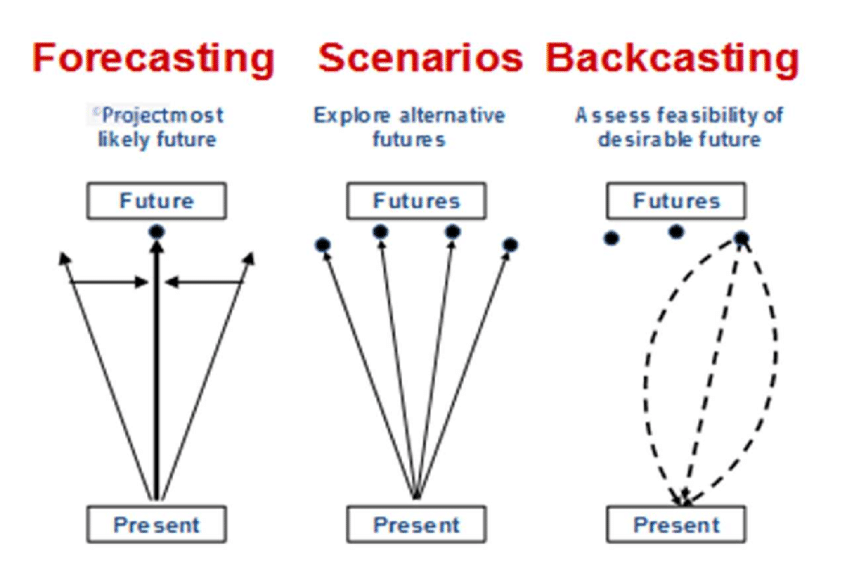
When forecasting looks at the most likely future based on current trends, Scenarios looks at multiple likely futures and backcasting assess the feasibility of the desired future(s) by working backwards. Of course backcasting is just one small piece in the big pie of getting to the desired future.
How to use it in a real life scenario?
So imagine the writers of the show ‘Report from 2050’ had started with their desired outcome, Sweden is carbon neutral by 2050. But how do we get there? What strategic thinking do we need to do?
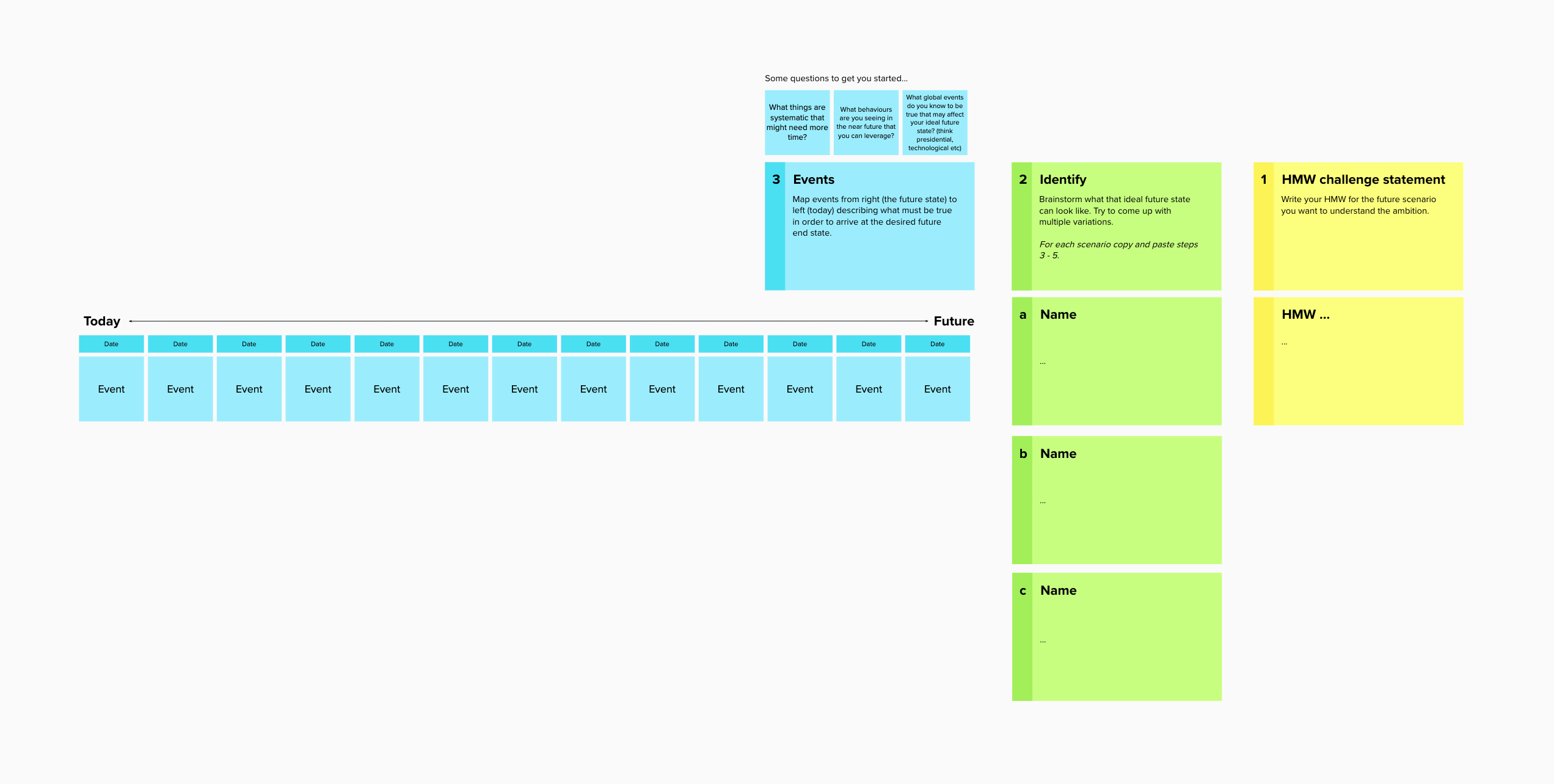
Like any complex problem, first you start with a challenge statement
- Write your HMW for the future scenario you want.
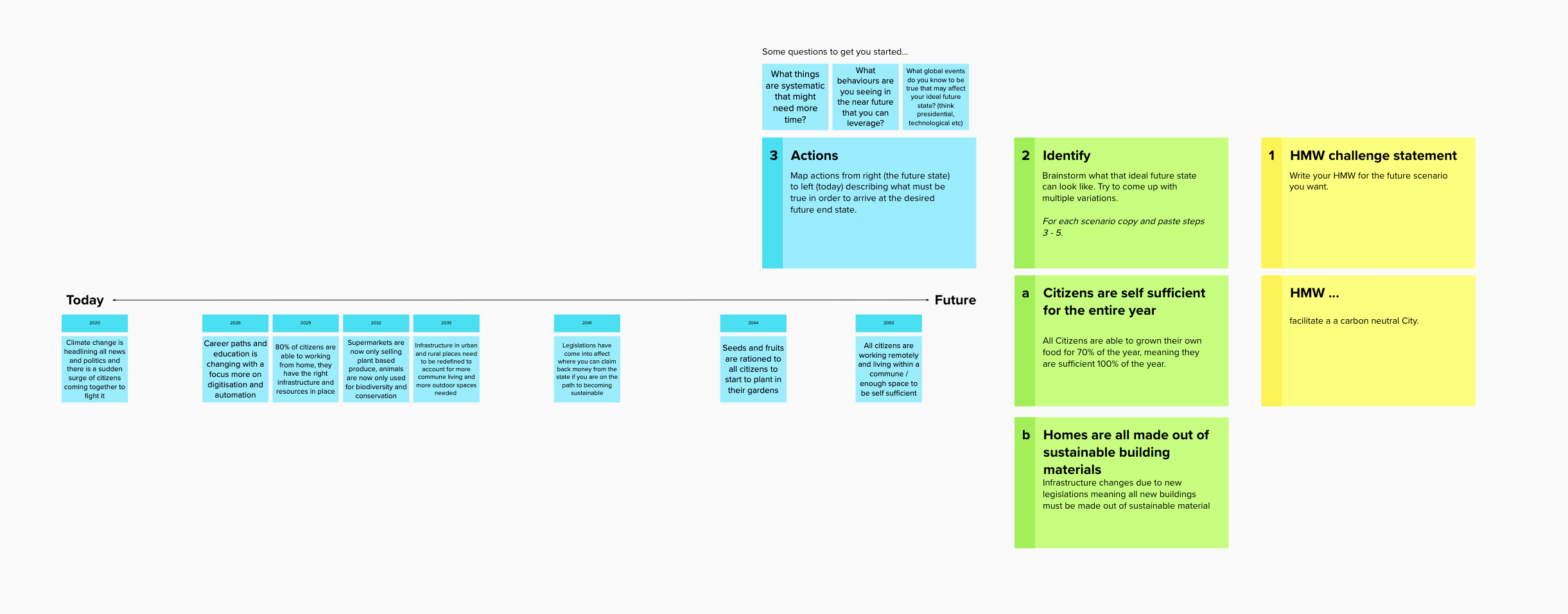
How might we…facilitate a a carbon neutral City. (this can also be more product driven of course.. HMW facilitate connection between similar communities to combat loneliness) - Brainstorm and Identify the ideal future state(s) regardless of whether it is achievable with the technology and financial resources of today
Citizens are self sufficient for the entire year
Homes are all made out of sustainable building materials - Map events from right (the future state) to left (today) describing what must be true in order to arrive at the desired future end state.
This can be quite a hard stage so there are a couple of starter questions to help.
What things are systematic that might need more time? (therefore need to be later in the timeline)
What behaviours are you seeing in the near future that you can leverage in the now?
What key technology things happen in cycles you can map (launching 5G or new smartphone launched every 4 years)
I imagine these three parts are done in a project kick-off or product/service vision session, try to involve as many people from the business as possible in this part. It’s great to bring different perspectives to the table and it’s a great exercise to get people to think more visionary. Maybe you already have a robust product/service vision and you need to pivot your business in steps 4 and 5.
If we use ‘Report from 2050’ as an example.
Our future is 2050, and in order for us to get there we need some quite big actions to take place, things around legislations (to change human behaviour), infrastructure and education.
By mapping them out in roughly the right areas we can start to see the stepping stones we need to pass to get to our desired future.
Normally that is where you stop with backcasting, once you have completed some actionable next steps… But what about trends that we can’t predict or global pandemics that are unknown. These things can either disrupt the action plan, or it can accelerate it.
Back in 2018, I ran a service design course in Kochi, India we wanted to see how service design thinking could be used to prevent future disasters (if you want to read more about that head here). I have been thinking about prevention for a long time, and what with COVID-19 all those things have surfaced again.
So what if we map out the known external factors based on the current climate and behaviours and see how that affects our events in step 3. Understanding what is going on now and how behaviours have changed and seeing if it can prepare us for what is coming up in the short term. What actionable next steps do we need to facilitate in order to get to our desired future state knowing that in times of crisis there are often short term products that come out to act as a band-aid solution.
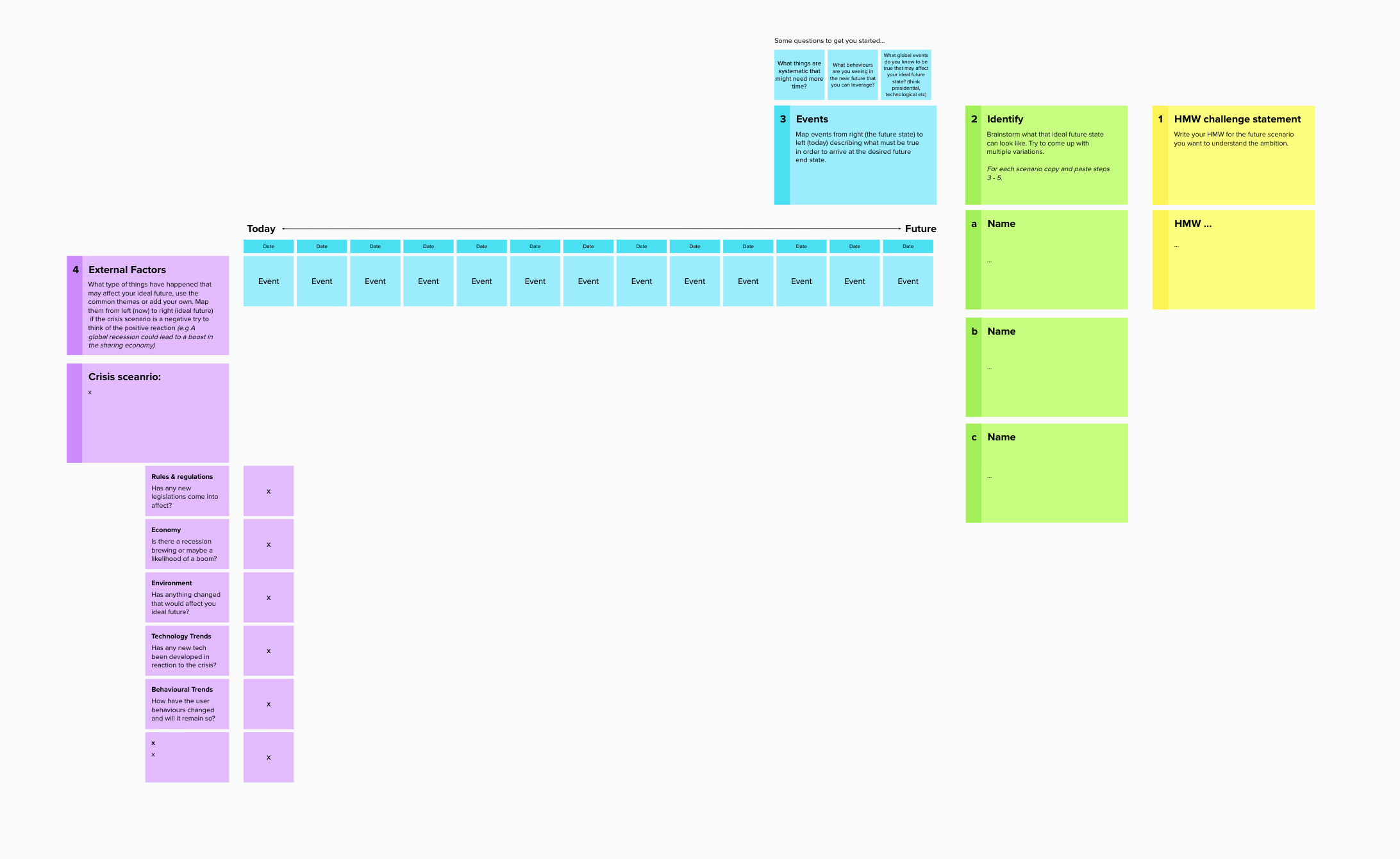
6. Map out all of the known external factors focusing from left to right that could affect your actions based on the current climate (if you are in the midst of a crisis) and what immediate affect that might have in a few months/years time. If you need some inspiration check this out.
5. Map out your key assumptions focusing from left to right (of course the more into the future you get the more unknown your assumptions will be)
Let’s take COVID-19 as an example.
There is a global pandemic called COVID-19 that creates a complete lockdown globally, the economy gets a hit but the environment gets a breakthrough. The market is now much more likely to change more quickly than any other market. How by mapping out what we know now, and in the near future can we design for our mapped out ideal future in step 2.
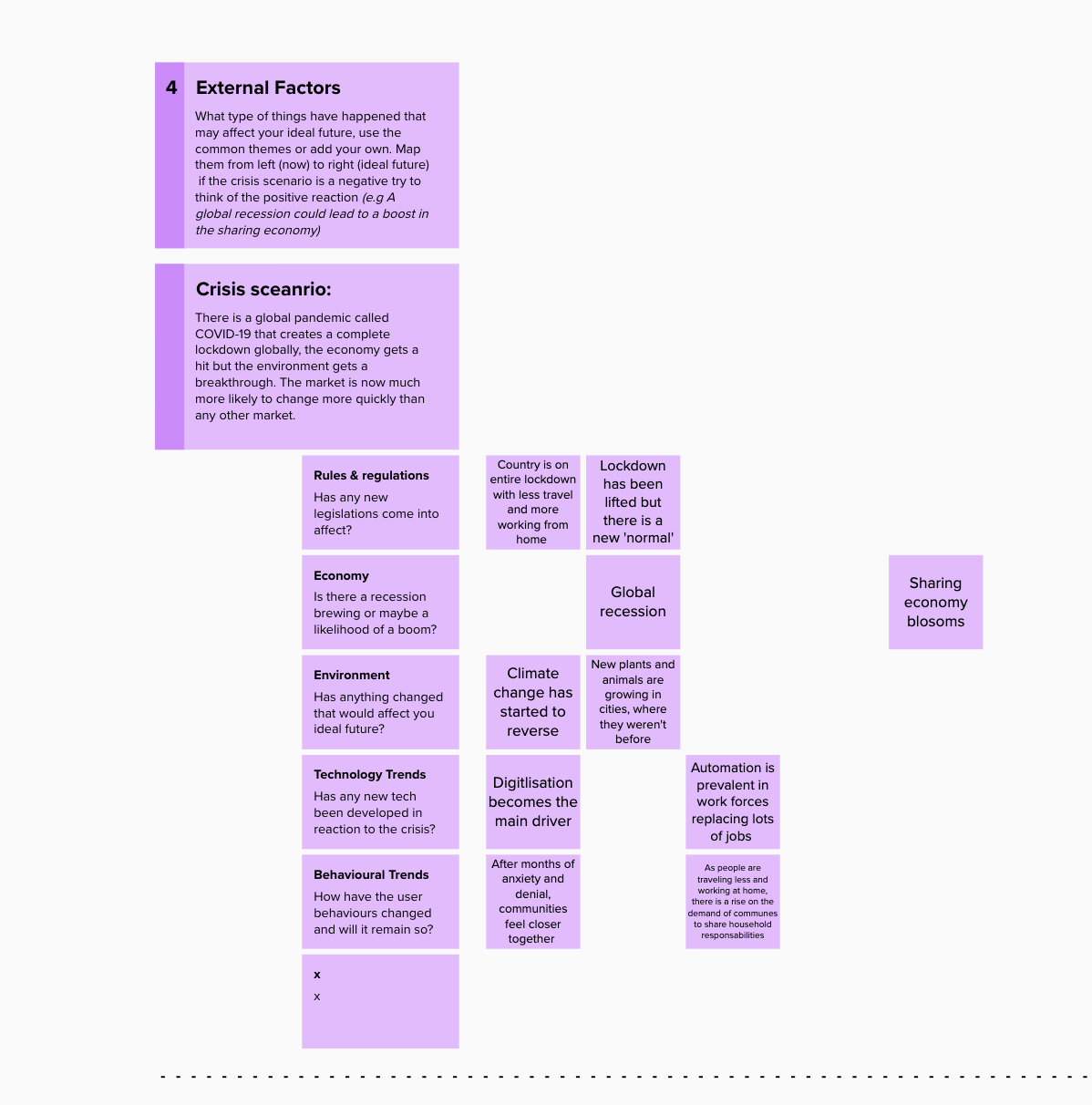
6. Reviewing your assumptions you can start to map out opportunity areas (new features or future research needed etc) to help with some actionable next steps.
This is just the first version of this tool, that I used to understand how to pivot during crisis scenario, on reflection could this tool be used to get the entire team forward thinking of the vision of the service based on external factors within society or the business that may affect the overall vision? Let’s see.
Some starting questions to think about…
What tangible things could you get out of this framework?
When is best to use this tool (in a workshop part of the work process) and when in the service lifecycle (during pivots or kick offs)?
If this at all tickles you, please feel free to use the mural template I have created here.
I would love your feedback on the thinking behind this tool. If you have taken a look and think something looks wrong/complicated or you have improvement suggestions please comment on this post below!
 Leila Byron
Leave a comment