
I have just finished 📖 User Friendly: How the Hidden Rules of Design Are Changing the Way We Live, Work, and Play 📖 which attached historical examples as to how design has evolved and in particular within the UX field. If you are interested to see what is next on my reading list just check it out here.
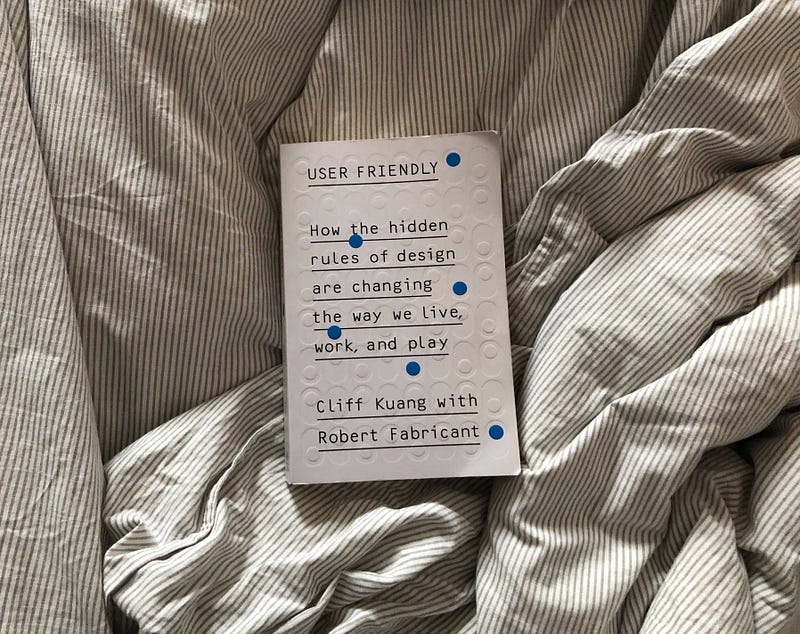
There was one chapter that got me thinking. Metaphors. In design school we are taught from very early on that most design decisions and influence can be baked into a metaphor. It allows the user to easily identify and understand it, by making the connection with something that is known to them and therefore can make the cognitive jump to what they are seeing/experiencing/feeling at that given moment. One of the most well known example of this is in digital design with the connection to the desktop computer; floppy disk to save, trash can to delete and a letter to send.
But with recent generations not even knowing what a floppy disk is (other than the icon for saving documents) and having grown up with a cellphone (as opposed to a telephone receiver), what is the evolution of these metaphors? Icons are good at representing objects but terrible at representing behaviour over time.
Behavioural Metaphors
Searching for behaviours over time and service design metaphors led me to this great blog post from Erik Flowers where he makes 3 analogies to service design.
- Through the end-to-end game play of Super Mario Brothers and by finding different ways to look at the end to end journey of lots of people, all at once
- The link to a Sci-Fi book called “Foundation” which illustrates that predicting the behaviour of a single individual doesn’t extrapolate to the behaviour of large groups of people
- A hike of a National Park mirroring that of a service ecosystem and defining service design as a distinct job of seeing the whole hike at once and mapping out all the traversals people can take on top of and through it
When we create service experiments or beta’s we are often looking for service patterns as a way to prototype new behavioural experiences, but when do metaphors go beyond influence and turn into patterns and models?
I have been looking at educational behavioural models to see how that could be translated into other experiences, to see if there are any learnings we could bring from the practice of education into another service experience.
Montessori is based on some fundamental things (whether people agree or disagree with the practise is another debate). It was developed by Maria Montessori, the first female Italian doctor, in the early 20th century. She used her training as a scientist and doctor to carefully observe children, and designed a school meant to appeal to their nature, rather than fight it.
“The three years of Montessori is like ‘baking a cake.’ The first year the child gathers the ingredients, the second year the child mixes them together, and the third year the child bakes the cake. Consequently, all three stages have to be achieved in order to see the final result.”
Montessori was built when Maria Montessori lived during a time of world wars and global upheaval. Perhaps for this reason, she placed great emphasis on peace education.
She believed that the future of the world depended on us teaching our children the importance of peace and this belief is still reflected in Montessori schools today. There is a great emphasis on community, both the classroom community and the wider global community we’re a part of. Children learn about the world and also learn tools for calming themselves and conducting peaceful conflict resolution.
Described below is ‘The Four Planes of Development’ which is the philosophy behind everything Montessori does and based on the ‘baking a cake’ metaphor above. Within each stage there is a line of progression which ends with a peak of sensitive periods, followed by a line of regression which includes refinement and acquisition of skills.
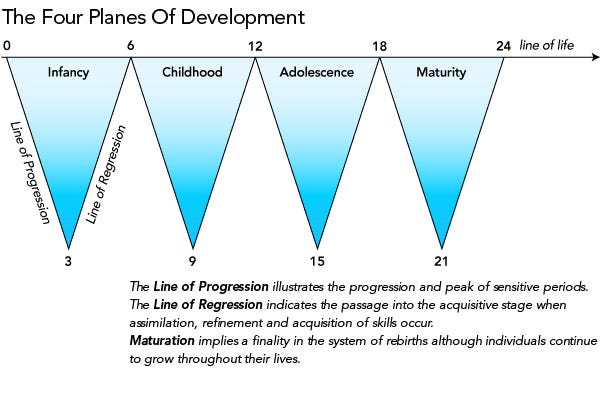
Understanding the development stage of a child to new things, I am wondering if we take these principles and use this as a model for new long term experiences, beyond education and beyond just kids. Of course the mental model and science behind Montessori is based on research on children but what if we can extract the fundamental idea.
If we remove the context of child learning. We are left with some clear principles.
- Sensitive Periods for learning : growth takes place across four scientifically based stages of development, and each of these stages has different needs within the learning cycle
- A prepared environment : environment is carefully designed to make learning an experience
- Independence and discovery : individual approach that allows development activities and learning experiences that follow each specific needs and readiness
As Montessori was built off the back of a world war and created 100 years ago, and as we approach the “new normal” and a time for a major digital metaphor revamp, I am wondering what we can take from the baking a cake metaphor, and the Montessori philosophy and build our new normal. I have been left with more questions than answers, just some food for thought (another meaty metaphor there).
In a post covid world… What will we be fighting against and what are we longing for? How can behavioural models and metaphors from history prepare us to build something new? Are we longing for our own “peace” by trying to learn new things, be more analog, live a simpler life? How can digital play a part in that? What does the Montessori approach tell us about how we consume and digest new learnings?
 Leila Byron
Leave a comment