If you’ve read my writing, you know I’ve spent years on climate, and you know I’ve been critical of AI on environmental grounds. My recent posts have shifted toward AI, and I can see how that might read as a pivot. It isn’t. The environmental objections still stand. What’s changed is my reading of what opting out actually costs. Opting out of AI is not the political act you think it is.
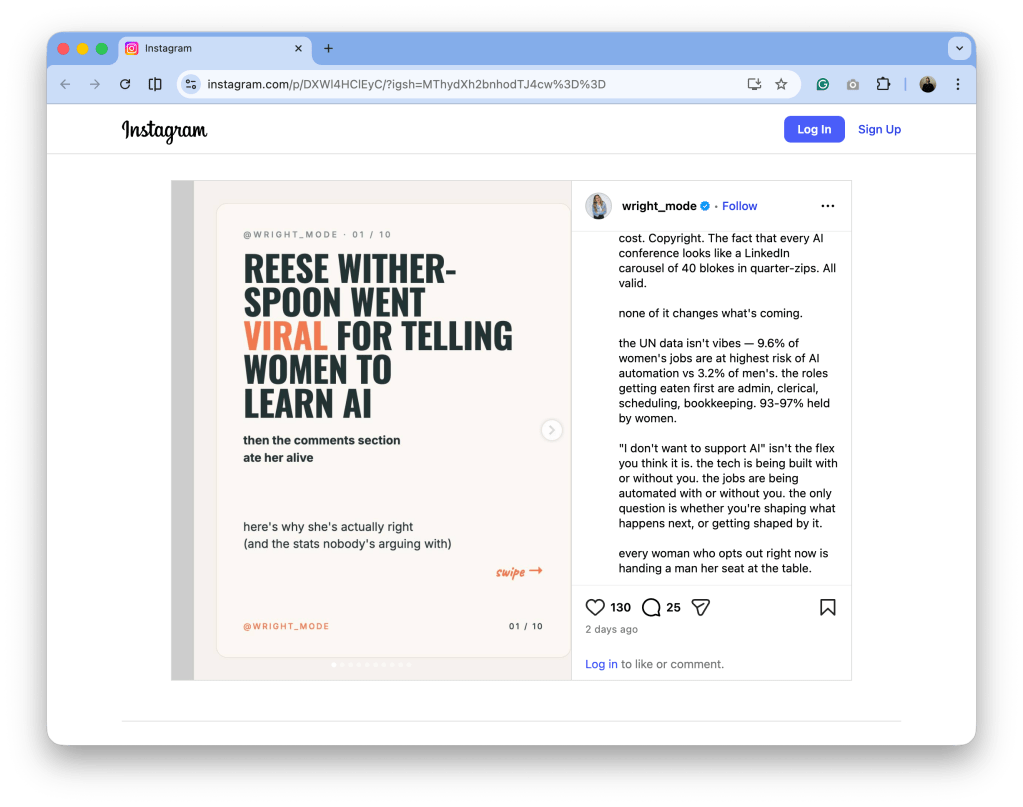
A few days ago, Reese Witherspoon told a room of women to learn AI, and the people in the comments were not happy about it. Every objection people raised was real, and to be honest, I have had the same thoughts: the environmental cost, the copyright questions, the fact that every AI conference/leadership team still looks like a very white male-dominated showcase. But I kept thinking the same thing: the arguments are right, and the conclusion is dangerous.
The women sitting this one out aren’t registering a protest, they’re handing someone else a promotion.
The numbers don’t lie
The UN’s latest labor analysis put 9.6% of women’s jobs in the highest-risk category for AI automation, against 3.2% of men’s. The roles getting swallowed up first are administrative support, clerical work, scheduling, and bookkeeping, which are between 93% and 97% held by women. The Stanford AI Index reports women make up 22% of the world’s AI talent, 18% of AI researchers, and less than 15% of senior AI executive roles. These aren’t marginal gaps they’re structural ones, and they compound.
What they compound into is this: Deloitte’s 2024 research found women at work are 22% less likely to feel encouraged to use generative AI, 30% less likely to be trained in it, and only 27% are planning to upskill in AI this year, against 38% of men. Coursera’s global training data shows women made up fewer than a third of people taking AI courses worldwide. Every one of those gaps is contributing to the bigger problem.
And this isn’t landing on neutral ground. McKinsey’s Women in the Workplace 2025 report found that for the eleventh consecutive year, women are underrepresented at every level of the corporate pipeline, holding just 29% of C-suite roles globally, unchanged from the year before. Only half of companies say they’re actively prioritising women’s career advancement, and that share has been declining. AI isn’t introducing the imbalance; it’s landing on top of one that has refused to move for over a decade, and accelerating every part of it that was already bad.
What the backlash actually reveals
I understand the backlash to Reese’s post that the idea that women should personally absorb the cost of upskilling on a technology with real ethical problems when no one seems to be asking men to do the same ethical math. The tech industry is asking women to personally absorb the ethical cost of a technology we had almost no hand in building. So the resentment is legitimate but the cost is coming anyway.
The thing the criticism misses is that the criticism and the instruction are operating at different levels. The critique is political and the upskilling is positional. You can be right about the externalities and still get passed over for a promotion by someone worse at your craft but fluent in whatever tool the VP of Engineering demoed at the last all-hands. That isn’t a moral failure, it’s an operational one.
The quiet mechanism
Here’s the mechanism that actually worries me, because it’s the one that won’t look like bias.
Most companies are now running some version of “AI enablement” two-week sprints, intensive blocks, and hands-on sessions. On paper, they’re open to everyone, but in practice, attendance skews male. Not because women are uninterested but because women at work already carry disproportionate administrative and caregiving loads. Optional, time-intensive, and not actively championed by leadership is a filter, and the filter selects for slack in your schedule, which typically women have less slack.
Then they run that filter through a promotion cycle in late 2026. Who’s fluent? Who’s shipping with the new tools? Who got to experiment when the stakes were low? The answer will be, disproportionately, the people who had room in their calendar this year. And the hiring panel that reviews external candidates in 2027 will be looking for exactly those signals. No one needs to be explicitly biased, the bias is already baked into who got trained.
This is how a decade of workforce diversity progress gets quietly undone in eighteen months.
What actually works
The companies that are moving on this aren’t the ones that care more but they’re the ones that made a structural decision: they tied executive compensation to the numbers, and they committed to being judged publicly.
Salesforce set a public, time-bound target 40% women-identifying and non-binary employees globally by the end of 2026 and tied a portion of executive pay to hitting it. Their representation at SVP and above has risen five percentage points since 2022. Cisco ties executive bonuses to diversity outcomes, not as a gesture but as a performance metric. McKinsey’s research is clear on why this should matter beyond equity:
gender-diverse executive teams are 25% more likely to outperform on profitability, and AI products built by gender-diverse teams show 15% fewer bias-related errors.
The business case has existed for a decade but the willingness to be judged by it has not.
What I’d say to the women being told to learn AI
Learn it. I hate that the advice lands on you harder than it lands on men. I hate that your ethical hesitation is being used against you. And I still think the only move is to learn it.
The technology is being built with or without you. The jobs are being automated with or without you. The only real question is whether you’re in the room when someone decides what the tool does next, and right now, the only entry into that room is fluency. You can critique the thing and use it at the same time; that’s not a contradiction. But being in the room to make those decisions around ethical use is the one powerful thing we can do.


Leave a Reply